

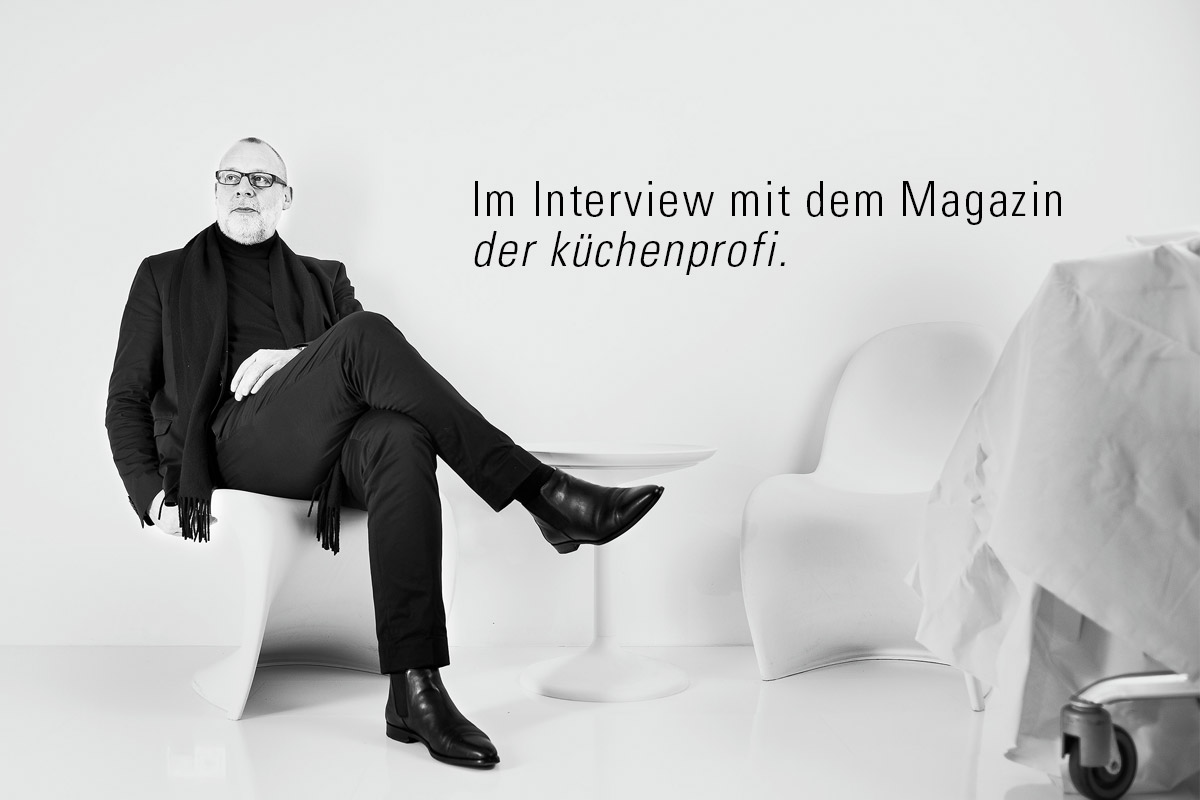
Rainer Kalesse interviewed by the trade magazine »der küchenprofi«, June 2017
RAINER KALESSE launched his own design management office in Lemgo in spring 2017, after more than 26 years as chief designer at Nolte Küchen. His field covers the complete range of services, from the product idea through design and marketing strategy to presentation for sales promotion at trade fairs and at the point of sale.
Only marginal improvements, or the great evolution after all: What really moves the supply industry in its interplay with its industry partners? »der küchenprofi« asked Rainer Kalesse, experienced chief designer at Nolte Küchen and now a self-employed coach in Lemgo, about his impressions of Interzum and its afterglow for future challenges.
der küchenprofi: Interzum came to a successful close on May 19. A pioneering fair, because companies in the supply industry are always forward thinkers for the industry as well. What inspired you most personally, Mr. Kalesse?Rainer Kalesse: Interzum 2017 was very impressive for me too. Especially with regard to the international character of exhibitors and visitors, but also in terms of impulses for new design approaches, materials, technologies and fittings. With fittings, it is evident that smooth running and closing comfort, even down to design, have now reached absolute perfection, and the topic of multifunctionality is also being played more broadly. Equally impressive were movement systems for functional furniture, such as “Qanto” from the company Ninka, which combine storage space with ergonomics. On ecology, the company 3B from Italy presented a spectacular and promising concept: recycling PET bottles for use in high-quality foil fronts. Particularly with regard to materials, the industry is under enormous displacement competition. Good ideas and new approaches are needed here. The best example from my past at Nolte Küchen is »Lacklaminat« (lacquer laminate), a name I coined myself about four years ago and which has developed into a real boom throughout the industry. But it came with a price aggressiveness that would not have been necessary. Since this high-quality material system has now arrived at the very bottom, new topics are needed that offer better value creation for everyone involved. As for surface and haptics, in my opinion there are no outstanding new developments. Materiality in terms of wood and stone looks seems to be almost exhausted.
der küchenprofi: What do you see as the megatrends in the kitchen sector?Rainer Kalesse: Megatrends are not limited to shape and color; furniture has to deliver more performance. That means it has to become smarter and more multifunctional. As a small, innovative example, I would just mention the 360-degree fitting for counter elements from the company Pöttker. Equally impressive were movement systems for functional furniture that combine storage space with ergonomics and promise a high degree of desirability. As for design in principle: purely angular, flat fronts are meeting headwind. Attention to detail and distinctiveness through shapes, frames and decorative accents are returning to the furniture landscape. Just as an example, the edge finish »Diamond Cut 22.5°« from TZ Austria. Everything is becoming noticeably homelier.
der küchenprofi: The diversification of the range, and with it the spectrum of styles and design options for industry, keeps growing. Is this really so important for furniture making and sales today, or rather a blind alley?Rainer Kalesse: I consider the extreme expansion of diversification an absolute blind alley. The biggest task for the furniture industry – with emphasis on the larger industrial companies – is to create new possibilities through intelligent collection development. This is a very demanding challenge and requires intensive engagement. The excessive product variety, especially in the kitchen furniture industry, could by contrast also be described as an arms race among themselves – however, it tends to lead consumers to confusion or even reluctance to buy.
der küchenprofi: Individualization must above all pay off economically for manufacturers. Can this become an advantage for smaller and medium-sized companies?Rainer Kalesse: The flexibility of smaller companies can be an advantage, but it doesn't have to be. Because it is always overall management that counts, and whether an idea is pursued with the right consistency. Individualization is a big task for all industrial companies, but today it is measured almost exclusively in quantity and variety. In my view, the guiding principle of Ikea founder Ingvar Kamprad, »Make more from less!«, still holds true. Ultimately it is about intelligent, conceptual product development that offers a high degree of individuality without increasing variety.
der küchenprofi: Variety without a greater depth of range sounds difficult. How can this be achieved?Rainer Kalesse: You can, for example, develop décor concepts with significantly fewer colors or décors that still cover all possibilities and, through intelligent interlinking, generate strong-selling products.
der küchenprofi: Variety can ultimately also overwhelm planners. Does retail make full use of the possibilities at all? What could be improved?Rainer Kalesse: That is exactly the decisive point. The furniture and kitchen furniture industry constantly develops new products without providing the planner with corresponding application examples and support. Furniture retail has hardly understood the new possibilities, and new ones are already being offered to it.
der küchenprofi: In the past, the kitchen set the tone for new developments – today one gets the impression that new impulses come more from the living area. Especially when you think of the handle-less purism of the eternally white kitchens. Would you share this view?Rainer Kalesse: Impulses come from both directions today, because the areas increasingly interlock and influence each other. In the past, the kitchen was very technically oriented; today, homely accents are added.
der küchenprofi: Do you believe, for example, that after the tendentially “colorless” kitchens with the dominating shades of white, black or grey, real colors will, as in the living area, have better chances again in future?Rainer Kalesse: I consider real colors appropriate in future only for accents. However, I wouldn't underestimate the grey trend. It is a clear alternative to white and conveys a noticeably new impression. Grey can also radiate high quality and is extremely compatible with other materials. Warm grey also conveys more of a feel-good atmosphere than cold, clinical white can. In architecture, too, the color grey has already made big waves and stands for modernity.
der küchenprofi: Technology today hides “conspicuously discreetly” in the background. Has the maxim »form follows function« turned into its opposite?Rainer Kalesse: I think relatively little of this maxim, since both components – form and function – must always be in harmony with each other, and in the development of a technical product, design should already be integrated in the concept phase. Really good design is characterized precisely by subordinating itself and coming across almost as a matter of course, thus forming an absolute unity of function and look. Really good design – and by that I mean form and function – is timeless and therefore truly long-lasting, and thus also economically successful.
der küchenprofi: One of the big trends is also that plastic surfaces imitate nature ever more perfectly, whether stone or wood, even bringing additional models of their own. Is authenticity therefore no longer a real added value?Rainer Kalesse: Authenticity in particular is a real added value, because wood surfaces have become more and more true to nature in recent years in terms of print and surface, and can hardly be told apart from the original. For the majority of consumers it is not necessarily about the original, but primarily about the material expression and the attitude to life associated with it. This makes materials affordable or, as with concrete, usable in the first place. So today it is above all about value and lifestyle, atmosphere and the corresponding feel-good factor, no matter whether so-called real materials or authentic reproductions are involved.
»The biggest task for the furniture industry is to create new possibilities through intelligent collection development, without increasing product depth.«
der küchenprofi: In general, we seem to live in an age of contradictions today: on one side high tech and urbanization, on the other a longing for emotion and love of the countryside. This continues with compressed storage and the quick kitchen versus generous space planning and professionalism. How can all this be brought to a common denominator?Rainer Kalesse: Everything polarizes. There are no uniform trends any more. But technology is one thing, emotionality another. The art will be not to overload furniture with technology but to integrate only as much as is really necessary. The electrification of drawers, for example, has not caught on. But it is precisely here that the topic »push to open« offers many new possibilities. One should always think from the customer's point of view. That is exactly what opens up many new opportunities to solve everyday problems, for example to meet the need for storage space or for more, or individually usable, additional work or table surface. Furniture can also offer multiple uses, and it should be fun!
der küchenprofi: Kitchen and living are merging more and more. Are the traditional structures in retail and industry dissolving as well?Rainer Kalesse: Kitchen and living are clearly merging more, and floor plans are changing as well, so that both areas are growing together more and more. But furniture retail still thinks and acts in the classic departments – kitchens, dining rooms, living rooms and bedrooms. Even the few furniture manufacturers who have the most diverse furniture in their portfolio do not manage the interlinking or see no sense in it. To me this is completely incomprehensible, since the customer is the same and interlinking could even offer advantages to the customer and thus also to the manufacturer. If furniture manufacturers and furniture retail do not react to the merging of living needs – online retail perhaps will. Only Ikea has a lead of miles here. The company integrates all living needs, from cutlery to lamp, in its sample apartments, which are presented absolutely true to reality. And it solves everyday problems such as storage solutions and multifunctionality very pragmatically. The kitchen industry, by contrast, often goes past the real circumstances and plans sample kitchens of 20 square meters and larger. Designing large spaces attractively is easy, but with small floor plans the planner is really challenged. And planning in small spaces in particular will become an important challenge in the future because of demographic change.
der küchenprofi: What do you believe, which social developments will shape product design most in future?Rainer Kalesse: Society will become ever more mobile, everything is in flux. The classic family, too, will work permanently ever less often. As a result, the home will become more important and valuable as an individual retreat for the individual. The kitchen opens up even more to the living space, becomes even more living space. Feeling comfortable and identification count. In addition, living space will become scarcer and more expensive, especially in conurbations. That means: apartments are not getting larger, so furniture must become ever smarter. Multiple use, multifunctionality and individuality are in demand. Furniture should therefore not only become permanently cheaper but be able to do more and thereby become more desirable. What is needed here above all are entrepreneurs with passion and vision.
Heike Lorenz